
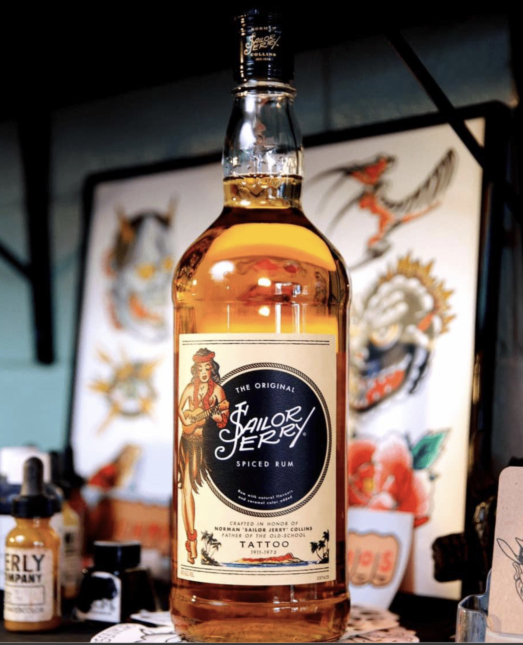
Sailor Jerry Spiced Rum Review
🦫 ANGUS RATING: 9.0/10 BEAVERS
Spirit: Sailor Jerry Spiced Rum
Type: Spiced Rum
Producer: William Grant & Sons
Alcohol Content: 46% ABV (92 Proof, U.S. version)
Tasting Notes: Vanilla, caramel, brown sugar, warm spice, molasses, and an intriguing fruitiness that changes with the way it’s served.
Bold, sweet, spiced, and full of character. A proper sailor’s rum with a surprising talent for making mixed drinks more interesting.
I. CROWLEY STORY
How a Scotsman, a Shipload of Pirates, and a Vomiting Deckhand Invented Rum
Ahhh, rum. There’s a spirit with a proper history.
Pirates, stolen cargo, Caribbean taverns, questionable women, and enough bad decisions to keep a Scottish magistrate employed for three lifetimes. Unlike whisky, which was developed through centuries of Scottish ingenuity and a deep appreciation for getting gloriously pissed, rum owes its existence to an extraordinary combination of greed, stupidity, and a few barrels of stolen molasses.
At least that’s how I remember it.
Historians will tell ye rum developed in the Caribbean during the seventeenth century, when somebody discovered that the byproducts of sugar production could be fermented and distilled into something considerably more entertaining than sugar.
They’re not entirely wrong, mind ye. They’ve simply left out the important people.
Namely, myself, a pirate captain named Bartholomew Briggs, and a particularly unfortunate deckhand named Ned.
Now, before we go any further, ye should understand that I’ve been around long enough to remember Scotland before the English started meddling in everything. My people were making whisky when half of Europe was still wondering whether bathing was a good idea. I’ve built stills, repaired stills, improved stills, and on one memorable occasion produced a batch of Highland whisky so magnificent that a visiting bishop lost his trousers, renounced three commandments, and proposed marriage to a goat.
The goat declined.
I’ve never blamed her.
Anyway, it was sometime in the seventeenth century when I found myself serving aboard a pirate vessel called the Indecent Mermaid. She was a fine ship, provided ye overlooked the leaking hull, rotten sails, and the unfortunate fact that nobody aboard knew precisely where we were.
Our captain, Bartholomew “Two-Barrel” Briggs, was a competent pirate but a spectacularly incompetent navigator. He once spent three days sailing toward what he confidently declared was Jamaica, only to discover we’d arrived in Cuba.
Rather than admit his mistake, Briggs accused the island of moving.
Nobody argued. The last fellow who’d questioned the captain’s navigation had been appointed Chief Anchor Inspector and invited to demonstrate his expertise underwater.
Briggs was also a greedy bastard, which, to be fair, was a fairly common qualification for piracy.
One afternoon, we intercepted a merchant brig carrying sugar, spices, bolts of cloth, and several enormous barrels of molasses. Briggs immediately ordered the molasses transferred to our hold.
“What’s the plan, Captain?” I asked.
“We sell it.”
“To whom?”
“Someone who wants molasses.”
“And what if nobody wants it?”
“Then we find someone who does.”
There it was. The entire philosophy of international commerce, reduced to three sentences by a man who couldn’t distinguish Jamaica from Cuba.
I was impressed.
For approximately three days, Briggs congratulated himself on his brilliant acquisition. Then I went below deck and discovered that one of the barrels had begun leaking.
And another.
And another.
By the time I fetched Briggs, the cargo hold looked as though someone had slaughtered an enormous black pudding. Molasses coated the deck, seeped between the planks, and clung to everything it touched. One sailor had lost a boot in the mess. Another had become stuck to a barrel and was demanding that someone fetch a priest.
Briggs stared at the disaster in horror.
“THAT’S OUR BLOODY PROFIT!”
“Aye, Captain. And unless ye intend to sell the deckboards, we’d best do something about it.”
We tried plugging the leaks with wood, tightening the barrel hoops, and wrapping the offending casks in canvas. One particularly enthusiastic fellow attempted to stop a leak with his trousers.
It worked reasonably well until he tried to put them back on.
Eventually, Briggs noticed several mostly empty beer casks sitting farther down the hold. They were large, reasonably sound, and contained just enough leftover beer to suggest the crew had been enjoying themselves.
“Put the molasses in those!” he ordered.
I looked at the casks, considered what little beer remained inside, and shrugged. They were going to lose the molasses anyway, and Briggs had already threatened to keelhaul the next man who offered an opinion.
We transferred the sticky cargo, added some water to make it manageable, sealed the casks, and resumed our voyage.
And that’s where things became interesting.
The Caribbean sun beat down on the ship for several days. Below deck, the heat was unbearable, the air smelled like a sugar plantation had exploded, and something peculiar was happening inside our salvaged beer casks.
The molasses was fermenting.
Of course, I recognized the process. I’d spent enough years making whisky to understand what yeast could do when given sugar, warmth, and sufficient opportunity to misbehave.
The rest of the crew had no bloody idea.
When the barrels began bubbling and hissing, Briggs assumed we’d somehow captured a family of sea monsters. He ordered the men to stand back while Ned, our youngest deckhand, investigated.
Ned was a pleasant enough fellow, although he’d been born with the unfortunate habit of attempting to drink anything that didn’t immediately attempt to drink him first.
He pried open a cask, sniffed the bubbling contents, and took a swallow.
His face twisted like an Englishman discovering he’d been invited to pay for his own dinner.
“That’s bloody awful!”
Then he took another drink.
Within ten minutes, Ned was singing. Shortly afterward, he began dancing with a coil of rope. Before the hour was finished, he’d fallen passionately in love with the ship’s parrot and was attempting to persuade her to marry him.
The parrot responded by biting his ear and calling him a stupid bastard.
A remarkably intelligent bird.
Briggs watched the proceedings with growing interest.
“Angus, is that boy drunk?”
“Aye.”
“From the molasses?”
“Apparently.”
“Can we sell it?”
There it was again. The magnificent commercial instincts of Captain Bartholomew Briggs.
I took a cup of the foul-smelling liquid and examined it. The molasses had fermented into a rough alcoholic wash, unpleasant enough to discourage any respectable drinker but full of possibilities to a Scotsman who knew his way around a still.
“We might be able to turn this shite into something useful,” I told him.
Briggs looked doubtful.
“How?”
“With that copper still ye stole from the Dutch merchantman last month.”
He frowned. “I thought that was a cooking pot.”
“Aye, well, that explains why yer stew tasted like copper and disappointment.”
We hauled the still into position, and I set about doing what generations of sensible Scotsmen had done whenever they encountered an alcoholic liquid that tasted like something scraped from the bottom of a ship.
I distilled the bloody thing.
The pirates gathered around, fascinated by the apparatus. Most had never seen a still operate, although several claimed to understand the principles perfectly. One insisted that the process worked because the copper frightened the alcohol out of the liquid.
I considered correcting him, then remembered that I served aboard a ship where the captain believed Cuba could move.
There are battles not worth fighting.
The first spirit we collected was a vicious little bastard. I took one sniff and felt my whiskers attempting to abandon my face.
“Not that portion,” I told Briggs.
He looked disappointed.
“Can we sell it?”
“Only to the English.”
His expression brightened.
But as the distillation continued, the spirit became more interesting. Beneath the rough edges came a sweetness from the molasses, a little warmth, and something fruity that hadn’t been present in the original wash.
It wasn’t whisky, certainly. No barley, no Highland peat, no familiar character from the spirits I’d known for centuries.
But it had promise.
I poured a little into a cup and handed it to Briggs.
He examined the liquid suspiciously.
“What’s it called?”
“Haven’t the faintest bloody idea.”
“Is it safe?”
“I’ve already tasted some.”
Briggs nodded thoughtfully, then handed the cup to Ned.
Now, I’ve always maintained that Briggs was an excellent judge of character, provided the character in question was someone he could persuade to take the first risk.
Ned took the cup, raised it to his lips, and swallowed.
For a moment, nothing happened.
Then his eyes widened.
His cheeks puffed out.
He turned a rather alarming shade of green and staggered toward the railing.
What followed was the most spectacular display of projectile vomiting I’ve witnessed in several centuries of maritime service.
And believe me, that’s saying something.
As the unfortunate lad leaned over the side, he began making a peculiar noise.
“RRRRRRR… UUUUMMMMM… RRRRRUMMMMM!”
Briggs stared at him.
“What the bloody hell’s he saying?”
I listened carefully as Ned continued decorating the Caribbean.
“Rrrrr… ummm…”
I stroked my whiskers.
“Sounds like he’s named it.”
“Named what?”
“The drink, ye daft bastard!”
Briggs looked at the cup, then at Ned.
“Rum?”
“Aye. Rum.”
“Because Ned’s vomiting?”
“Have ye got a better suggestion?”
Briggs considered the question for several moments.
“No.”
“Then rum it is.”
And that, my friends, is how rum received its name.
Not from some ancient Latin expression, obscure Caribbean dialect, or scholarly explanation involving centuries of linguistic development.
From a drunken deckhand attempting to empty his stomach into the Atlantic.
Naturally, historians disagree with me.
They claim there are other explanations for the word’s origins. I’ve heard them all, and frankly, they’re bloody boring.
Where were these historians when Ned was hanging over the railing?
Nowhere!
I WAS THERE!
And I’ve never forgotten the smell.
Once Briggs realized we’d accidentally created something people might actually pay to drink, his enthusiasm became unbearable. He started referring to himself as the Father of Rum, despite having contributed nothing to the process beyond stealing the molasses and repeatedly asking whether we could sell it.
I suggested that if anyone deserved recognition, it was Ned.
Briggs disagreed.
Ned was still being sick.
Over the following years, rum spread throughout the Caribbean, and the distillers who actually knew what they were doing began improving the rough spirit we’d stumbled upon aboard the Indecent Mermaid.
Different islands developed their own styles. Some produced lighter spirits, others richer and heavier ones. Spices found their way into bottles, barrels added character, and before long rum had become as essential to Caribbean commerce as sugar, ships, and questionable accounting.
Pirates drank it. Sailors drank it. Merchants drank it. Governors drank it, then passed laws pretending they hadn’t.
And, naturally, I drank it.
One of my favorite establishments during those years was a harbor tavern called the Salty Parrot, run by a woman named Marta.
Marta was six feet tall, built like a frigate, and possessed the temperament of a wounded Highland boar. She could throw a grown man through a window without spilling the drink in her other hand.
I know this because I watched her demonstrate the technique on a French privateer who complained about the price of her rum.
He landed in a chicken coop.
The chickens took exception.
Marta poured me a generous glass one evening and waited while I tasted it. The spirit was rich, warming, pleasantly sweet, and carried enough spice to remind me of the old days aboard the Indecent Mermaid—without the unfortunate aroma of Ned’s digestive system.
“Well?” she demanded.
I took another sip.
“That’s damned fine rum, Marta.”
She smiled, poured me another, and informed me that the first glass was on the house.
The second wasn’t.
Aye, Marta was a remarkable woman. Beautiful, terrifying, and possessed of business instincts that would’ve made Captain Briggs weep with envy.
I stayed at the Salty Parrot considerably longer than intended.
Which brings us, after several centuries of piracy, rum making, disastrous navigation, and the occasional disagreement with Frenchmen, to Sailor Jerry Spiced Rum.
Now there’s a bottle that understands the sort of company rum ought to keep.
Named in honor of Norman “Sailor Jerry” Collins, the legendary American tattoo artist whose work became inseparable from maritime and tattoo culture, this rum doesn’t arrive wearing a silk waistcoat and demanding that ye contemplate its delicate sophistication.
It’s bold, straightforward, and carries enough character to make ye suspect its ancestors spent considerable time aboard ships where the captain had outstanding arrest warrants.
And when I bring a glass to my nose, the vanilla, caramel, brown sugar, and warm spice remind me of those old Caribbean taverns.
Not the polished establishments they build for tourists.
The proper ones.
The ones where the floor was sticky, the music was loud, the rum was plentiful, and the proprietor could throw a Frenchman through a window without interrupting a conversation.
I reckon Marta would’ve approved of Sailor Jerry.
Though she’d probably have challenged him to an arm-wrestling match before agreeing to serve it.
And as for Ned?
Well, if the poor bastard were alive today, I’d raise a glass in his honor.
After making damned certain he’d finished being sick.
Now, let’s pour this magnificent bastard and see whether Sailor Jerry lives up to his name.
II. THE POUR
The Nose — Vanilla, Spice, and a Hint of Something Fruity
Sailor Jerry makes a good first impression. Bring the glass to your nose and the familiar sweetness of vanilla, caramel, and brown sugar comes forward, accompanied by warm spice and an underlying molasses character.
There’s enough going on to hold your attention without turning the experience into a scientific examination. The aromas are approachable, rich, and inviting, with a boldness that suits the rum’s maritime personality.
But there’s another characteristic worth noticing, one that could easily be overlooked beneath the sweeter aromas.
Fruitiness.
Not an overwhelming tropical-fruit explosion, and not a single identifiable fruit announcing its presence. It’s a softer fruit character that sits among the vanilla, caramel, and spice, giving the aroma another dimension.
It’s noticeable when the rum is poured neat, although it doesn’t dominate the nose. And as we’ll discover, it’s a remarkably elusive little bastard once the ice and mixers come out.
Angus has encountered men like that in taverns. They make a wonderful first impression, then disappear when the bill arrives.
With Sailor Jerry, however, that elusive fruit character turns out to have a rather useful purpose.
III. THE TASTE
Neat — Where the Fruit Reveals Itself
Sailor Jerry delivers a sweet opening, with vanilla and caramel leading the way. Brown sugar and molasses provide a richer foundation while warm spice builds across the palate.
For a spiced rum bottled at 92 proof in the United States, it presents a bold yet approachable character. There’s warmth, certainly, but it doesn’t overwhelm the sweeter flavors.
And here’s where that intriguing aroma makes another appearance.
The fruitiness detected on the nose is also present when Sailor Jerry is sipped neat.
It’s a subtle quality rather than the principal flavor. For a brief moment, it adds a little brightness and complexity to the sweeter caramel, vanilla, and molasses notes.
But it doesn’t linger.
As the sip develops, the fruit fades quickly, allowing the spice and richer sweetness to take over.
It’s an interesting transition, particularly because the fruit seems determined to make itself known without staying long enough to be properly identified.
Angus has a theory about that.
“The fruit’s like Ned aboard the Indecent Mermaid. Makes a brief appearance, causes a little excitement, then disappears before anyone can ask the bastard what he’s doing.”
Nevertheless, the neat pour offers the clearest opportunity to recognize this particular flavor. It’s also an excellent way to understand the rum’s balance of sweetness, warmth, and spice before changing anything.
On the Rocks — The Fruit Retreats
Adding ice changes Sailor Jerry’s character.
As the rum chills and dilutes, the sweetness and spice remain, but the overall experience becomes somewhat softer.
The familiar vanilla, caramel, and brown sugar are still present, while the warmth becomes less pronounced.
The fruitiness, however, takes a significant step backward.
On the nose, only a vague suggestion of fruit remains. On the palate, it’s almost entirely absent.
That doesn’t necessarily make the rum less enjoyable. It simply changes what stands out.
With ice, Sailor Jerry becomes more focused on its familiar sweet and spiced character. The fruit note that briefly added another dimension to the neat pour is largely lost.
For someone who prefers a chilled, sweeter spiced rum, that may be perfectly acceptable.
But if you’re interested in discovering everything Sailor Jerry has to offer, the difference is worth experiencing.
“Aye, the fruit’s still aboard somewhere,” Angus observes, examining his glass. “But the moment the ice arrived, the cowardly bastard hid below deck.”
Mixed — Where the Fruit Finally Earns Its Keep
Here’s where Sailor Jerry becomes particularly interesting.
When mixed into a cocktail or a simple long drink, the fruitiness behaves differently from what you might expect.
You generally can’t identify it as a distinct flavor.
It’s not sitting there demanding attention. It doesn’t overpower the mixer or announce itself as a separate fruity ingredient.
In fact, unless you already knew to look for it, you might never realize it was there.
Yet it contributes something important to the finished drink: additional flavor and depth.
The vanilla, caramel, brown sugar, and spice provide the recognizable character of Sailor Jerry, while that underlying fruitiness helps round out the combination.
Instead of standing apart from the other ingredients, it becomes part of the overall flavor.
And that’s what makes the result interesting.
The fruit note is most recognizable neat, nearly disappears over ice, and becomes difficult to distinguish when mixed—yet its contribution to the finished drink is where it really shines.
That’s a very different quality from a flavor that simply gets stronger or weaker depending on how the spirit is served.
Sailor Jerry isn’t merely bringing sweetness and spice to a mixer. There’s an additional character working underneath those more obvious flavors, helping create a more satisfying whole.
“Now that’s clever,” Angus declares. “The fruit does bugger all on its own, vanishes when ye add ice, but put the bastard to work with the rest of the crew and suddenly everybody’s pulling their weight!”
For anyone who enjoys rum cocktails or mixed drinks, this is one of Sailor Jerry’s most appealing qualities.
It’s a rum with enough personality to be enjoyed on its own, but it also has the ability to contribute more than just alcohol, sugar, and spice to a mixed drink.
And that, my friends, is a useful talent.
IV. THE FINISH
Sailor Jerry finishes warm, sweet, and pleasantly spiced.
The vanilla and caramel linger, accompanied by brown sugar and a gentle, lasting warmth. The molasses character helps give the finish some richness, while the spice leaves a recognizable impression without completely dominating the experience.
The fruitiness noticed earlier is short-lived when the rum is tasted neat. It has largely disappeared before the finish settles in.
On ice, that fruity character contributes little to the finish, leaving the sweeter and spicier notes to carry the experience.
In mixed drinks, its contribution is less about a distinct lingering fruit flavor and more about the depth it adds to the overall combination.
The result is a finish that’s approachable but not entirely simple.
Sailor Jerry has enough sweetness to encourage another sip, enough spice to maintain its personality, and enough warmth to remind ye that this isn’t a glass of bloody fruit punch.
“A respectable finish,” Angus declares. “Warm, satisfying, and just enough fire to remind ye the bottle wasn’t filled by a Presbyterian Sunday school committee.”
V. ANGUS’S VERDICT
A Bold Spiced Rum With More Going On Than First Meets the Nose
Sailor Jerry Spiced Rum isn’t pretending to be the most sophisticated rum ever produced, and that’s precisely part of its appeal.
It’s bold, sweet, warming, and unapologetically spiced.
Vanilla, caramel, brown sugar, molasses, and warm spice establish its familiar character. Together, they create a rum that is approachable enough for someone exploring spiced rum while retaining enough personality to remain interesting.
But what makes Sailor Jerry particularly noteworthy is the subtle fruitiness running through the experience.
It’s easily detected on the nose, briefly recognizable when sipped neat, and almost completely absent from the flavor profile when served over ice.
Yet when Sailor Jerry is mixed, that fruitiness contributes a flavor and depth that may be difficult to identify individually but are nevertheless part of what makes the finished drink satisfying.
It’s a small detail, but an important one.
And it’s precisely the kind of characteristic that can separate a spirit with personality from one that merely tastes sweet.
How Angus Recommends Drinking It
Neat: An excellent choice for exploring Sailor Jerry’s full flavor profile, particularly the fleeting fruit note.
On the Rocks: A smoother, chilled presentation emphasizing the vanilla, caramel, molasses, and spice, while much of the fruit character fades away.
Mixed: Perhaps Sailor Jerry’s greatest strength. Its sweetness and spice remain recognizable, while the underlying fruit character contributes additional complexity and depth.
That versatility is one of the reasons Sailor Jerry earns its place among the better everyday spiced rums in Angus’s drinking cabinet.
It isn’t trying to impress ye with an elaborate pedigree or convince ye that enjoying rum requires a leather armchair, a silk smoking jacket, and a vocabulary borrowed from a French perfume salesman.
It’s a straightforward, flavorful spiced rum that knows what it does well.
And does it damned well.
As Angus puts it:
“Sailor Jerry reminds me of those old Caribbean taverns. A little sweet, a little spicy, plenty of warmth, and something interesting lurking underneath that ye can’t quite put yer finger on.”
“Now, is it the finest rum I’ve ever tasted? No. Marta’s was better, and that magnificent woman could’ve distilled seawater into something worth fighting over.”
“But would I drink Sailor Jerry again?”
“ABSOLUTELY!”
“Would I recommend it?”
“Without hesitation!”
“Would I attempt to recreate the original rum experiment?”
“Not a bloody chance. The last time I tried, the wash ate through a copper bucket, the captain accused Cuba of moving again, and Ned proposed marriage to a goat.”
“The goat declined.”
“Apparently, word gets around.”
🦫 FINAL RATING: 9.0/10 BEAVERS
Bold. Sweet. Spiced. Versatile. And carrying a subtle fruit character that earns its keep when the rum meets a mixer.
One Beaver deducted because Marta’s was better.
And she still owes Angus a window.
Slàinte!
Angus “Pub” Crowley
Dam Spirited Lodge — Serious About Spirits. Not Much Else.
About this review: The tasting notes reflect firsthand observations of Sailor Jerry Spiced Rum served neat, over ice, and mixed. Angus Crowley’s historical adventures, including the Indecent Mermaid and Ned’s alleged invention of the word “rum,” are fictional satire. The spirit, its producer, and the person for whom it is named are real.