
🦫 ANGUS RATING: 5.0/10 BEAVERS
“There’s a good whisky hiding in there somewhere. Unfortunately, the smoke has barricaded the bloody door.”
I. CROWLEY STORY — JOHN WALKER, A BURNING BOG, AND AN ENGLISHMAN WHO SHOULD HAVE BEEN LEFT IN IT
I’ve drunk some magnificent Scotch in my time. I’ve also drunk whisky that could strip the paint off a battleship, dissolve a man’s memories, and leave his descendants waking up with hangovers three generations later. I’ve made whisky, distilled whisky, aged whisky, ruined whisky, and once accidentally created a batch so powerful that a Highland priest declared the entire barn possessed.
But I’ve always maintained that a proper Scotch ought to taste like whisky.
Not a forest fire. Not a chimney sweep’s trousers. And certainly not a peat bog that somebody extinguished with water they’d been storing behind a sheep shed since the Battle of Culloden.
Which brings me to Johnnie Walker Double Black.
Before ye question my qualifications, let me explain something.
I knew John Walker.
Aye, the actual John Walker. The grocer from Kilmarnock who started his business in 1820 and eventually lent his name to one of the most recognizable whiskies on the planet.
John was a clever fellow. Practical, hardworking, and blessed with the sort of patience required to deal with customers who believed their opinions were worth more than the contents of their wallets.
I first met him in his grocery shop on a miserable Scottish afternoon when the rain was coming sideways, the streets were ankle-deep in mud, and the English were presumably somewhere inventing a tax on umbrellas.
John was behind the counter arranging bottles when I walked through the door, soaked to the whiskers and in no mood for conversation.
“Afternoon,” he said.
“Is it?” I replied. “I thought the sun had resigned.”
He chuckled and offered me a dram.
Now, John understood something that many whisky merchants of his day hadn’t quite figured out: people generally appreciate knowing what the bloody hell they’re buying. One bottle shouldn’t taste like Highland heaven while the next resembles something strained through a dead badger.
So he experimented with blending whiskies, looking for consistency, character, and balance.
I respected that.
His son Alexander would later help turn the family business into a whisky empire, but even in those early days, John understood the value of making something worth buying twice.
Unfortunately, he also had the occasional terrible idea.
One afternoon, he invited me to sample a particularly smoky experiment.
“Angus,” he said, holding up a glass, “I think this one might need a touch more peat.”
I sniffed it and nearly swallowed my tongue.
“John, if ye add any more peat to that bloody thing, ye’ll be able to plant potatoes in it.”
He laughed.
Then, the stubborn bastard, he considered adding more anyway.
Our discussion was interrupted by the arrival of an English gentleman named Sir Reginald Puddlesworth, who had somehow acquired a considerable fortune without acquiring the slightest understanding of anything useful.
Reginald wore polished boots, a ridiculous waistcoat, and a hat tall enough to attract its own weather. He announced that he’d come to Scotland to investigate the whisky business because, in his words, “the English could undoubtedly improve upon the process.”
I looked at John.
John looked at me.
Neither of us was particularly surprised. The English have been trying to improve things they don’t understand since somebody first handed them a map.
Reginald had developed a theory.
According to him, Scottish whisky owed its character entirely to peat smoke, and therefore the obvious solution was to expose the whisky to as much smoke as humanly possible.
“More smoke means more Scottishness!” he proclaimed.
“By that reasoning,” I replied, “ye could crawl up a chimney and become Robert the Bruce.”
He ignored me.
Within the hour, Reginald had persuaded himself that the finest whisky in the world could be produced by constructing an enormous peat fire beside a makeshift barrel shed.
John wisely declined to participate.
I attended because somebody needed to witness the disaster for historical purposes.
Reginald stacked peat until the pile resembled a small Highland burial mound. He soaked it with lamp oil, struck a match, and stood back with the satisfied expression of a man who had absolutely no idea what he’d just done.
The resulting inferno was magnificent.
Flames shot upward. Black smoke rolled across the hillside. Sheep fled in every direction, and a passing farmer accused us of attempting to summon the Devil.
“EXCELLENT!” Reginald shouted. “LOOK AT THAT WONDERFUL SMOKE!”
Then the wind shifted.
The smoke swallowed him.
He emerged coughing, stumbling, and waving his arms like a drowning goose.
“PUT IT OUT! FOR GOD’S SAKE, PUT IT OUT!”
Naturally, the idiot had failed to bring sufficient water.
What he did have was an enormous wooden trough filled with stagnant rainwater, rotting vegetation, and substances I strongly suspected had once been alive.
The water was greenish-brown, smelled like a neglected horse stable, and contained something that moved when nobody was touching it.
Reginald seized a bucket and began throwing the disgusting mixture onto the burning peat.
The steam that rose from the fire was unlike anything I’ve smelled before or since.
Imagine burning earth, charred wood, wet leather, old socks, and a swamp that’s recently been informed its wife is leaving.
Then imagine somebody deciding to bottle the experience.
I stood beside John, watching the smoke creep across the hillside.
“Well,” John said eventually, “that’s certainly distinctive.”
“Distinctive?” I replied. “John, I’ve smelled plague pits with better manners.”
Reginald staggered toward us, blackened from head to toe, and announced that his experiment had been a complete success.
“The most intense Scottish character imaginable!” he wheezed.
I looked at the smoking bog.
I looked at the stagnant water.
Then I looked at John.
“If anybody ever makes a whisky that smells like this,” I told him, “I want nothing bloody well to do with it.”
John laughed so hard he nearly dropped his glass.
For years afterward, whenever he offered me something particularly smoky, he’d ask whether I thought Reginald had been involved.
And we’d both laugh.
Eventually, John passed on, Alexander expanded the business, and the Walker name became famous throughout the world.
Then, many generations later, somebody handed me a bottle of Johnnie Walker Double Black.
I opened it.
I sniffed.
And suddenly, I was standing beside that burning peat bog again.
I could practically hear Reginald screaming.
“MORE SMOKE MEANS MORE SCOTTISHNESS!”
“Sweet suffering Christ,” I muttered. “The English bastard finally got his revenge.”
II. THE POUR — A SCOTCH WHISKY WITH A SMOKE PROBLEM
Now, before I start insulting the contents of this bottle, let’s establish what we’re dealing with.
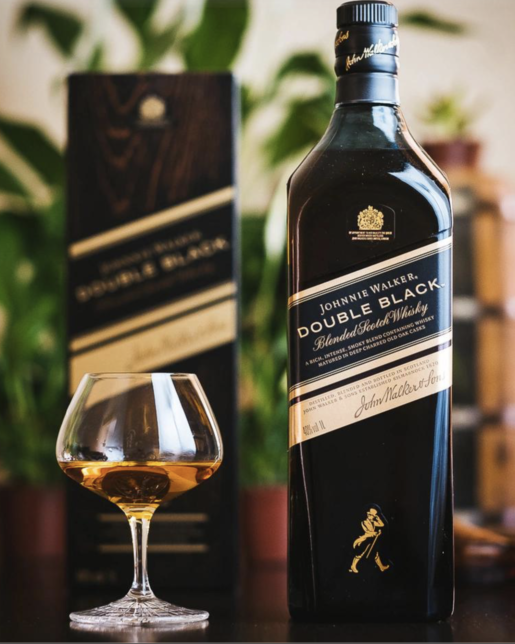
Johnnie Walker Double Black is a blended Scotch whisky bottled at 40% alcohol by volume, or 80 proof. It was created as a more intensely smoky expression of the familiar Black Label style, using selected smoky whiskies and whiskies matured in deeply charred oak casks.
There’s genuine blending craftsmanship involved here, and I won’t pretend otherwise simply because the result tried to fumigate my tasting room.
Johnnie Walker Black Label is a respectable whisky. I enjoy its balance of malt, fruit, sweetness, oak, and restrained smoke. The different elements work together rather than attempting to murder one another.
Double Black, on the other hand, appears to have appointed smoke as dictator and ordered every other flavor into hiding.
I poured myself a dram and gave it a moment to settle.
Then I approached the glass.
The first impression was unmistakable: smoke, peat, charred oak, and dark, earthy aromas.
There was no gentle introduction. No welcoming handshake. No friendly little suggestion that something interesting might be waiting underneath.
The whisky marched straight up my nostrils, planted a flag, and declared the territory permanently occupied.
I tried again, hoping the initial assault might settle into something more recognizable.
It didn’t.
I could detect the oak beneath it, along with a heavy, damp earthiness that reminded me of turning over peat after three days of Highland rain.
And that’s when Reginald Puddlesworth’s miserable water trough returned to haunt me.
It wasn’t simply the smoke that bothered me. I’ve enjoyed plenty of smoky Scotch over the centuries. A well-handled smoky whisky can be magnificent, adding depth, warmth, and a wonderfully rugged character.
This was different.
The smoke felt enormous, the peat relentless, and the overall aroma darker and damper than I wanted.
Johnnie Walker might describe the experience as bold and brooding.
I would describe it as a damp Highland bog suffering a catastrophic disagreement with the local fire brigade.
Still, I hadn’t tasted it yet.
And I believe every whisky deserves the chance to defend itself before I sentence it to the English.
III. THE TASTE — SOMEWHERE UNDER ALL THAT SMOKE IS A PERFECTLY RESPECTABLE WHISKY
My first sip confirmed my suspicions.
Smoke arrived first.
Peat followed immediately behind it.
Then came more smoke, apparently accompanied by several relatives who’d decided to stay for the weekend.
Oak and spice eventually made themselves known, along with a darker sweetness struggling beneath the commotion.
I rolled the whisky across my tongue, searching for the underlying character. There was structure here, certainly, and enough complexity to suggest that somebody had put considerable thought into the blending.
But the smoke was driving the wagon, the peat was holding the reins, and every other flavor had been tied up in the back.
I swallowed, considered the experience, and took another sip.
That’s when things became more interesting.
Vanilla, dark caramel, dried fruit, and oak began emerging from behind the smoke.
There it was!
A glimpse of the whisky I’d been hoping to find.
The sweetness wasn’t particularly delicate, but it provided some welcome relief from the relentless peat. The dried-fruit character brought depth, the caramel added richness, and the oak gave the whole thing a solid backbone.
For a few wonderful moments, I was enjoying myself.
“Now we’re getting somewhere,” I told the glass.
Then the smoke came back.
Of course it bloody did.
It returned like an angry Doberman discovering that somebody had stolen its dinner.
I took another sip, trying to determine whether the sweeter flavors could establish themselves for longer.
They appeared again, but only briefly. Every time the whisky began showing its more appealing qualities, the peat charged back into the room and shouted everybody else down.
And that, to me, is Double Black’s central problem.
I don’t object to smoky Scotch. I object when the smoke prevents me from enjoying the Scotch underneath it.
Blending is supposed to be an art of balance, even when the intended result is bold.
A good blend reminds me of a proper Scottish pub band: malt, grain, fruit, spice, sweetness, and smoke all contributing something worthwhile.
Double Black reminds me of that same band after somebody gives the bagpiper six additional instruments and tells the others to shut the hell up.
There’s talent in the room.
I just can’t hear most of it.
IV. THE FINISH — THE GUEST WHO REFUSES TO BLOODY LEAVE
If ye enjoy an aggressively smoky finish, Double Black has something special prepared for ye.
Unfortunately, that something is even more smoke.
The finish is long, warm, earthy, and peppery, with charred oak and peat hanging around well after the whisky has gone down.
I could still detect some of the underlying sweetness, but the smoky character dominated the experience.
And it lingered.
Good God, did it linger.
Now, I generally appreciate a whisky with a long finish. There’s something wonderful about enjoying a final sip and allowing its flavors to slowly unfold while ye sit beside the fire, contemplate the evening, or devise new ways to irritate the English.
But there’s a difference between a lingering finish and an unwanted houseguest.
Double Black reminded me of the fellow who arrives at a party promising to stay for one drink, then finds ye at two in the morning and begins explaining his divorce in extraordinary detail.
Ye offer him another drink.
He declines.
Ye offer him a blanket.
He refuses.
Ye point toward the door.
He starts talking about his mother-in-law.
That’s this whisky’s finish.
The smoke simply will not take a hint.
I sat there waiting for the peat to settle, hoping the oak, sweetness, or dried fruit might have the final word.
They didn’t.
The smoke remained firmly in charge.
I could practically smell Reginald’s burning peat pile again, along with that disgusting bucket of stagnant water.
“Fine,” I muttered. “Ye’ve made yer bloody point.”
The whisky, naturally, had nothing further to say.
It was too busy smoking.
V. ANGUS’S VERDICT — FIVE BEAVERS, ONE BURNING BOG, AND AN ENGLISHMAN’S DREAM
Here’s the part that genuinely frustrates me.
Johnnie Walker Double Black isn’t badly made whisky.
There’s real blending skill behind it. I can recognize the oak, sweetness, spice, caramel, vanilla, and dried-fruit character waiting beneath that enormous cloud of peat smoke.
The craftsmanship is there.
The problem is that I don’t particularly enjoy the result.
I want balance in my Scotch. Even when I choose something bold, I want the different flavors to complement one another rather than fight to the death over control of my tongue.
Johnnie Walker Black Label manages that balance far more successfully for my tastes.
Double Black seems determined to prove that anything worth smoking is worth smoking twice.
And perhaps that’s exactly what its admirers want.
If ye love heavy peat, dark earthy aromas, charred oak, and a finish that lingers like smoke trapped inside a wool coat, ye might absolutely adore this bottle.
Good for ye.
I’m not going to tell another whisky drinker what they’re supposed to enjoy.
But I’m also not going to award a magnificent rating to something that leaves me wondering whether my glass requires a chimney.
I found myself thinking about John Walker again.
I imagined him sitting across from me beside a roaring Highland fire, examining a dram of Double Black with that thoughtful expression he used to wear when deciding whether a blend needed adjustment.
“Well, Angus?” I could almost hear him ask. “What do ye think?”
“There’s good whisky in there, John. I found vanilla, caramel, dried fruit, oak, and enough blending skill tae impress a reasonable man.”
“Then what’s the problem?”
“Somebody set the bloody distillery on fire and forgot tae tell the whisky.”
He’d laugh.
Then he’d probably ask whether I wanted another glass.
And I’d give him the same answer I’d give anybody else.
“If I’m standing on a cold Highland hillside, wearing a wool coat, rain blowing sideways, a plate of venison waiting by the fire, and not another bottle of Scotch within fifty miles, then perhaps.”
“But otherwise?”
“I’ll have the Black Label, John.”
And I suspect he’d understand.
So here’s my verdict.
Would I drink Johnnie Walker Double Black? Aye, if it were the only Scotch available.
Would I buy it again? No.
Would I choose it over Johnnie Walker Black Label? Not a bloody chance.
Would I serve it to an Englishman? With enthusiasm, particularly if his surname happened to be Puddlesworth.
I give Johnnie Walker Double Black 5.0 out of 10 Beavers.
That’s not a complete failure. I can recognize competent whisky-making even when the final product isn’t something I’d choose for myself.
But five Beavers doesn’t mean I’m rushing out for another bottle.
It means I’ve acknowledged the craftsmanship, survived the experience, and have absolutely no intention of chasing the better flavors through a burning bog to find them again.
There’s a respectable Scotch buried under all that smoke.
Somewhere.
Unfortunately, the peat has barricaded the bloody door, the fire brigade has run out of water, and Reginald Puddlesworth is standing outside claiming the entire disaster was his idea.
Which, come to think of it, sounds about right.
FINAL RATING: 🦫 5.0/10 BEAVERS
“There’s a good whisky hiding in there somewhere. Unfortunately, the smoke has barricaded the bloody door.”
And if somebody from Johnnie Walker ever asks what I’d change about Double Black, my answer is simple.
PUT OUT THE BLOODY FIRE.
Preferably with something cleaner than Reginald’s water.
Slàinte, ye magnificent bastards!
— Angus “Pub” Crowley