
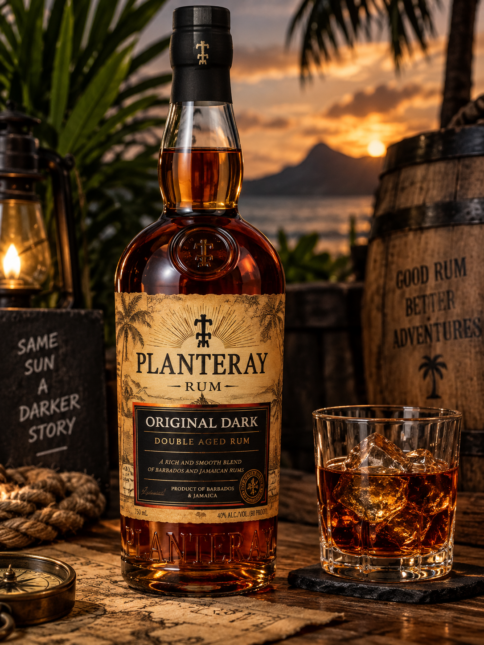
PLANTERAY DARK RUM: ANGUS RATING: 8/10 BEAVERS — THE BARBADOS RUM CONSPIRACY
Or: How Angus Crowley Accidentally Started an Entire Industry
Ahhh, rum. Now there’s a spirit with a proper history — pirates, sugar, molasses, ships, taverns, bad decisions, and enough alcohol to convince generations of sailors that swimming home was a perfectly reasonable method of transportation. I recently acquired a bottle of Planteray Original Dark. Lovely stuff. Turned the bottle around, read the label: “Barbados. Seventeenth century.” I nearly choked on my drink. Barbados? Seventeenth century? Aye. Now we’re getting somewhere. Because I was in Barbados in the seventeenth century, and I know exactly what happened. The problem is that nobody in Barbados remembered it. Not because they were stupid. Well… some of them were. Mostly because they hadn’t met me yet, and because at the time, the local record‑keeping system consisted primarily of drinking something, forgetting it, and blaming the English — which, to be fair, is still a perfectly respectable system.
After the incident aboard the Indecent Mermaid — which involved stolen molasses, a copper still, several pirates, and Ned discovering that his stomach had strong opinions about experimental spirits — we eventually made port in Barbados. Ned was still recovering. Briggs was still trying to figure out how we’d turned stolen molasses into something that could make a grown man fall in love with a parrot. And I had a barrel. A very important barrel. Inside it was the first proper batch of what Ned and I had named rum. We came ashore carrying the stuff. Naturally, we drank it. We’re pirates — what else were we supposed to do with it? We found a tavern. Then another. Then another. By sunset there were sailors stumbling through the streets singing about rum. By midnight there were fishermen singing about rum. By one in the morning there were merchants singing about rum. By two, there was a magistrate singing about rum. By three, the magistrate was dancing on a table with a woman named Gladys while wearing only one boot. I remember thinking: This is going exceptionally well.
The Barbadians had never tasted anything like it. They wanted to know what it was. “Rum,” I told them. “What’s rum?” I pointed at Ned. Ned was sitting on a barrel singing something that sounded vaguely Scottish. “That’s rum.” Ned looked up. “Rrrrr… ummmm?” “Aye.” He nodded solemnly, then fell off the barrel. Scientific demonstration complete.
Now here’s where history gets complicated. The Barbadians wanted more — naturally. So they asked me how to make it. I explained the process: ferment the molasses, distill the wash, collect the good spirit, don’t drink the stuff that comes out at the wrong bloody time. Basic distilling. I thought they’d understood. They hadn’t. They’d understood “make rum,” which frankly was the important part. Within weeks there were people fermenting molasses all over the island. Within months there were stills. Within a few years there were merchants shipping barrels. And before long, Barbados was producing enough rum to make sailors forget where they’d left their ships. That’s when I realized what I’d done. I’d created an industry. Not intentionally, mind ye — I was trying to make enough rum to keep Ned from drinking mine. But history doesn’t care about your intentions. It cares about what happens next.
Rum spread. Sailors took it to other islands. Merchants carried it across the Caribbean. Taverns started stocking it. Naval officers discovered that adding it to things made naval officers considerably more tolerable. Pirates embraced it immediately — naturally. And everywhere it went, people asked the same question: “Where did this come from?” Barbados. “Who made it?” Well… that’s where things get awkward. Because by then I’d already left, and the people I’d taught had developed a terrible habit of taking credit for things. That’s why the history books say Barbados invented rum. And technically… they’re right. Barbados did — after I showed them how. There’s a difference. It’s like saying the English invented whisky because they once found a Scotsman drinking it. You can write that down if ye like. I’ll deny everything.
Which brings us back to Planteray Original Dark. Barbados. Jamaica. Fruit. Spice. Vanilla. Orange. And enough Jamaican funk to make Ned suspicious all over again. I poured myself a glass, took a sip, then looked at the label. “Seventeenth century.” I nodded. “Aye.” Finally, somebody got the date right. They’ve still managed to leave out the Scotsman, but I’ll forgive them. After all, if I insisted on being mentioned every time somebody drank rum, we’d need considerably larger labels. And I’ve got better things to do — like drinking the bloody stuff. So let the historians tell their tidy little stories. Let them talk about sugarcane and molasses and fermentation and trade routes. Let them argue over dates. I know what happened. I was there. I made the first rum. Ned named it. We brought it to Barbados. The Barbadians drank it. Then everybody wanted more. And that, ladies and gentlemen, is the true, rum‑soaked story. You’re welcome. Now pour another. We’ve got several hundred years of catching up to do.
PLANTERAY ORIGINAL DARK RUM — 🦫 ANGUS RATING: 8/10 BEAVERS
Planteray Original Dark is a blend of rums from Barbados and Jamaica, which means somebody had the good sense to put two islands in a bottle and see what happened. Barbados brings the civilized manners, Jamaica brings the HOGO — and HOGO, for those of ye who’ve never had the pleasure, is that wonderful funky rum character that smells a little like the distillery forgot to wash its arse before coming to dinner. This is a dark rum with enough personality to make itself known without kicking the bloody door off its hinges, and I respect that. I’ve known a few Barbadians in my time. Good people. I’ve known Jamaicans too. Also good people. I’ve known both at the same bloody time. That was a long night.
The first thing that reaches ye on the pour is fruit — not some artificial candy‑shop nonsense either, but a soft sweetness underneath it, and then the vanilla starts poking its head out. Give it a sniff and ye know you’re dealing with rum. Not vodka pretending it has a personality. Not some clear industrial spirit wearing a coconut hat. Rum. There’s fruit, sweetness, vanilla, and lurking behind it all is that little Jamaican bastard grinning in the shadows: HOGO.
First sip? Bloody hell, there’s a lot happening. Sweetness comes first, then vanilla, spice and orange, with the HOGO sitting right there in the middle of the bloody conversation refusing to shut up. It’s complex — not pretentious complex, just a lot going on at once. The vanilla is particularly noticeable; it runs through the whole thing while the orange and spice keep it from turning into liquid vanilla pudding. And somewhere in the middle of all that, I stopped trying to identify individual flavors. Because sometimes ye taste something and the proper tasting note isn’t “candied orange peel with notes of Madagascan vanilla and toasted cinnamon.” Sometimes the proper tasting note is: “That’s fucking good.” There. I’ve saved ye ten minutes of bullshit.
The finish brings ye back around to where the whole thing started — fruit, sweetness, vanilla, spice, orange — only now it’s quieter. The opening comes in with its boots on; the finish leaves through the back door. It’s not a monstrous, lingering finish that’ll have ye tasting rum three counties away, but it doesn’t simply vanish either. And here’s where I discovered something important: don’t put the bloody thing on ice. I tried it. The flavor dropped away. All that interesting nonsense I’d just discovered neat became considerably less interesting, which is unfortunate because ice is normally one of my favorite food groups.
Now here’s where this bottle gets interesting. I tried mixing it with frozen mixed berries and lime — a sort of frozen daiquiri arrangement. I’ve made the same bloody thing with Sailor Jerry. With Sailor Jerry, it’s magnificent. With Planteray Original Dark? No. The berries and the rum met one another, exchanged unpleasant glances, and decided they had nothing further to discuss. The lime improved matters somewhat. It did not save the marriage. But then I tried the Planteray in coffee — and there it was. That’s where the bastard belongs. The vanilla, spice and dark rum character play beautifully with coffee. Now we’re talking. I suspect this rum would also make a fine Dark & Stormy, but I’ve currently managed to drink all the ginger beer in the bloody lodge, so that experiment shall have to wait. And I’m not about to manufacture evidence merely to satisfy a review. That’s how journalists get into trouble. That and honesty.
So here’s the Crowley verdict: Planteray Original Dark is bloody good rum. It’s flavorful, complex and particularly enjoyable neat. It’s got fruit, spice, orange, vanilla and enough Jamaican funk to remind ye that somebody in the Caribbean still knows how to make a rum with some bloody character. But don’t drown it in ice. Don’t throw northern berries at it. And if ye’ve got a cup of strong coffee nearby? Pour the rum. I’ll see ye there.
— Angus “Pub” Crowley 🦫🥃